
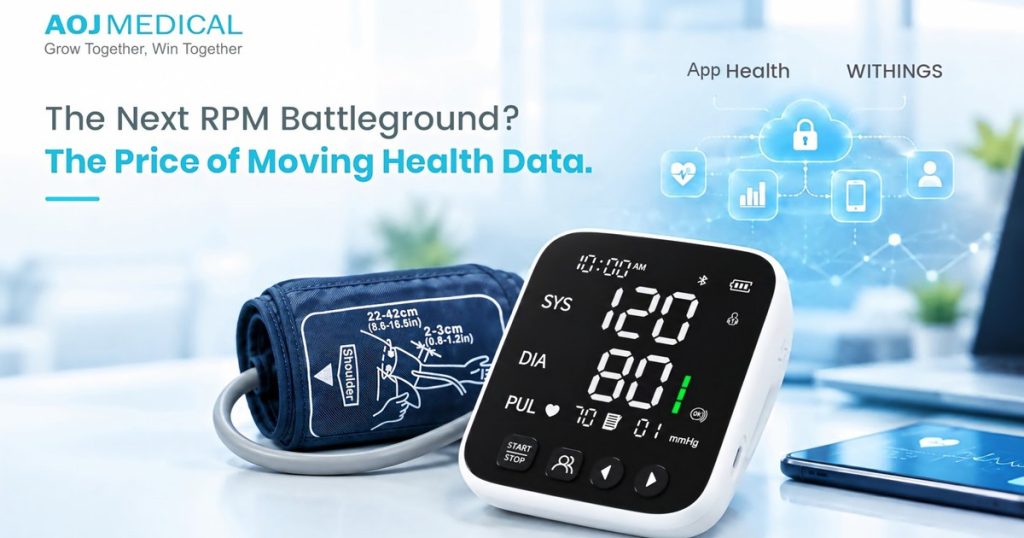
Two announcements, just one day apart, reveal an interesting tension in digital health.
October 12: Google Health announced deeper integrations with partners including Function Health, Abbott, and Flo Health — bringing more types of health information into a unified experience.
October 13: Withings introduced a new policy requiring new users to subscribe to Withings+ to sync their data with third-party apps such as Apple Health and Health Connect.
Existing Withings accounts remain unaffected, and manual data exports are still available.
But the contrast is striking. While some companies are racing to bring more health data together, others are beginning to charge for the ability to move it between platforms.
And that raises a much bigger question for the Remote Patient Monitoring (RPM) industry.
For years, we’ve treated interoperability mainly as a technical challenge. Can the device connect? Does the platform support the integration? Can readings reach the intended destination?
But interoperability is also becoming a commercial question: Who controls the data connection — and who decides what it costs?
For RPM providers managing hundreds or thousands of connected devices, this matters. A device’s purchase price is easy to calculate. The long-term commercial terms governing access to its data can be much harder to predict. A change in platform strategy, subscription pricing, or integration policy could influence the economics of an entire monitoring program.
To be clear, the Withings announcement concerns consumer app integrations, not a reported change to clinical RPM data services. Still, it highlights three questions worth asking before committing to any connected-device ecosystem:
- Is ongoing data integration included in the commercial agreement?
- Who controls future pricing and access conditions?
- Can a provider switch platforms without replacing perfectly functional hardware?
For medical device manufacturers, including us at AOJ Medical, this is an important reminder: a connected device is not just hardware. It’s part of a much larger commercial ecosystem.
And perhaps the next phase of competition in RPM won’t be defined only by device capabilities — it may also be defined by who offers the most sustainable and flexible relationships around the data those devices generate.
Should health-data interoperability be a premium subscription feature — or a fundamental part of connected healthcare?