
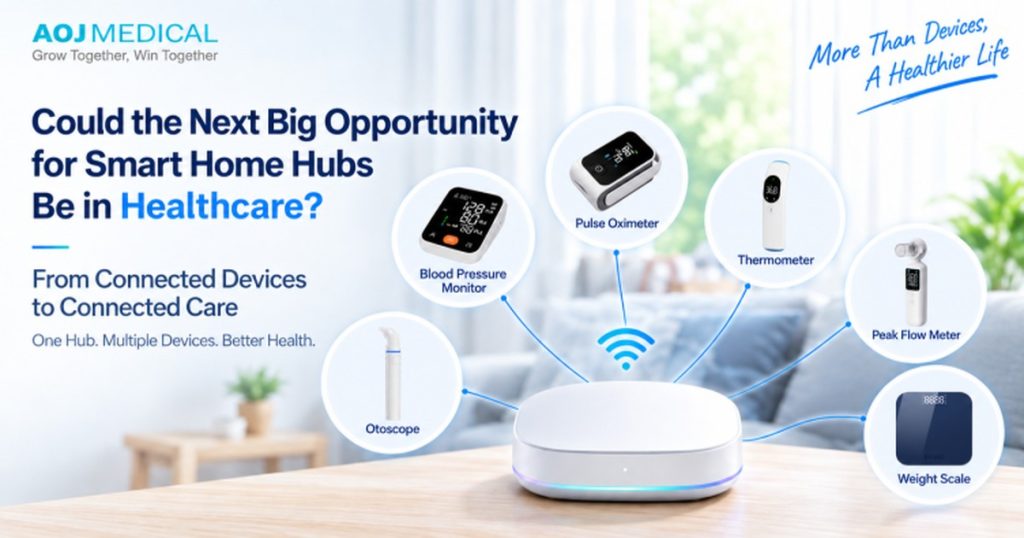
Apple’s latest HomeView launch highlights an interesting shift in the smart home industry: from managing individual devices to connecting everything through one central hub.
This got us thinking: could Remote Patient Monitoring (RPM) benefit from the same approach?
Today, home health monitoring often involves multiple devices — blood pressure monitors, weight scales, pulse oximeters, glucose meters, and more. But as the number of devices grows, so does the complexity of connectivity, data transmission, and ongoing maintenance.
What if one RPM Hub could connect multiple monitoring devices across a household? By automatically collecting readings from compatible devices and uploading them through a shared network connection, a centralized Hub could bring several important advantages:
- Lower Total Cost — reduce duplicated connectivity resources and overall deployment expenses.
- Simpler Maintenance — streamline device setup, connectivity management, and technical support.
- Better Data Adherence & Continuity — minimize manual data transmission steps, helping patients maintain more consistent monitoring routines.
- A More Scalable RPM Ecosystem — support multiple monitoring devices through a shared household infrastructure.
And perhaps the biggest opportunity isn’t just cost reduction. It’s making reliable health data collection a natural part of everyday life, rather than an extra task for patients.
Of course, building such an ecosystem raises another interesting question: what’s the best way to connect medical devices to a central Hub? At AOJ, we’ve developed two different approaches — one based on Bluetooth connectivity and another using direct Pogo Pin connections. Both share the same vision, but take different technical paths.
The future of RPM may not be about adding more connected devices, but connecting them in a smarter way.