
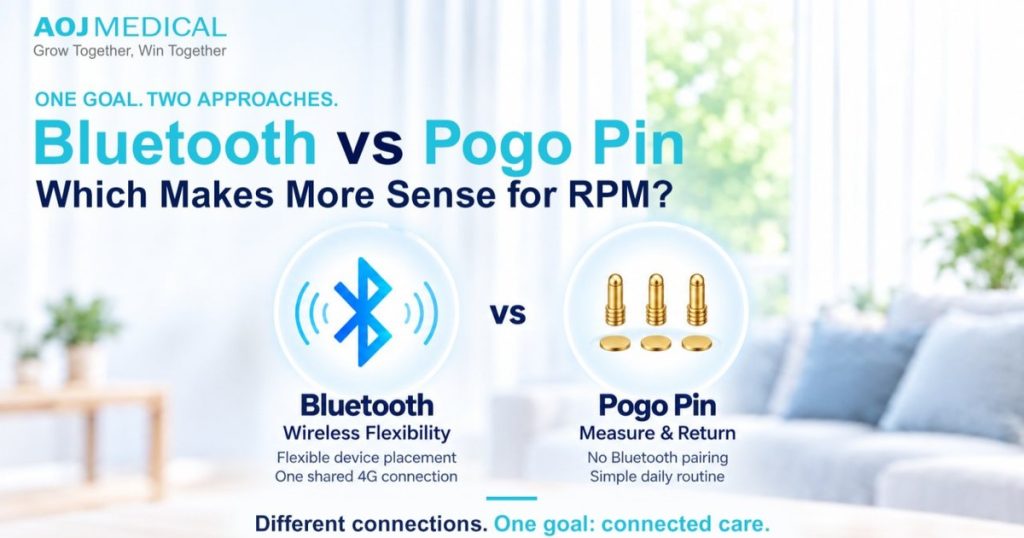
In our last post, we explored how a centralized Hub could simplify home-based Remote Patient Monitoring (RPM). But here’s another important question: what’s the best way to connect multiple medical devices through one Hub?
There isn’t a one-size-fits-all answer. At AOJ Medical, we’ve been exploring two different approaches, each designed to address different RPM needs.
1. Bluetooth-based Hub: Flexibility & Wireless Connectivity
Imagine a blood pressure monitor that does more than measure BP. With integrated Bluetooth and 4G connectivity, it can also serve as a central gateway — collecting readings from compatible devices such as pulse oximeters, thermometers, and weight scales, then automatically uploading the data to the cloud.
Why it matters:
- Wireless flexibility for different home monitoring setups
- Support for multiple types of monitoring devices
- One shared cellular connection instead of separate 4G modules in every device
2. Pogo Pin-based Hub: Simplicity & Reliability
What if patients didn’t need to worry about Bluetooth pairing at all? With a Pogo Pin-based docking solution, patients simply take their measurements and return the devices to their designated slots. Physical contacts transfer the stored readings, while a shared 4G BP monitor handles cloud connectivity.
Why it matters:
- No Bluetooth pairing or smartphone app required
- A simple “Measure & Return” routine, especially helpful for elderly patients
- Fewer wireless connectivity challenges and lower overall connectivity hardware costs
Different technologies. Same destination.
Both approaches aim to address some of RPM’s biggest challenges: reducing deployment and maintenance costs, simplifying the patient experience, supporting better data adherence and continuity, and making multi-parameter monitoring more scalable.
The real question isn’t which technology is more advanced. It’s which approach makes consistent, long-term monitoring easier for the people using it. Because in RPM, successful connectivity isn’t just about getting devices online — it’s about keeping patients connected to care, day after day.
Which approach do you think better fits the future of home-based RPM: wireless flexibility or plug-and-play simplicity?